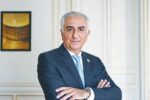




In a world where revolutions often bury crowns, the possibility that Iran, a nation marked by 46 years of theocracy, might contemplate the return of a monarchy sounds like an improbable echo from a distant past. However, in the summer of 2025, the figure of Reza Pahlavi, the exiled Crown Prince of Iran’s last shah, has resurfaced strongly, fueling speculation about a radical shift in the country’s destiny. From his exile on the outskirts of Washington D.C., Pahlavi, 64, has intensified his call for a transition to a secular democracy, as cracks in the ayatollahs’ regime become increasingly visible. Is this the moment for a new chapter for Iran, or merely a nostalgic dream of a past that no longer resonates with new generations?
Reza Pahlavi’s story is, in itself, a reflection of Iran’s convulsions. Born in Tehran in 1960, he was named Crown Prince in 1967, during the reign of his father, Mohammad Reza Pahlavi, whose monarchy was overthrown in 1979 by the Islamic Revolution. At 17, Reza was already in the United States, training as a fighter pilot in the Air Force, when his father’s regime collapsed. Since then, he has lived in exile, first in Morocco, then in Egypt, and finally in America, where he earned a degree in political science and started a family. But his life has not been that of a common exile. For four decades, Pahlavi has advocated for a free, secular, and democratic Iran, maintaining contact with opponents inside and outside the country. “I do not seek political power, but rather to help our great nation navigate this critical hour towards stability, freedom, and justice,” he declared at a conference in Paris in June 2025, in a speech that resonated as a manifesto of leadership in waiting.

The current context seems to give him an unexpected boost. The combination of economic sanctions, disastrous management, and recent military attacks by Israel and the United States against Iranian nuclear facilities have weakened the ayatollahs’ regime like never before. In a video posted on X on June 17, 2025, Pahlavi stated: “The Islamic Republic has come to an end and is collapsing. Khamenei, like a frightened rat, has hidden underground and lost control of the situation.” His words, full of symbolism, seek to galvanize a population exhausted by decades of repression and economic hardship. According to a Newsweek report published on June 18, 2025, Pahlavi does not explicitly advocate for restoring the monarchy, but for a free referendum that allows Iranians to choose between a constitutional monarchy or a republic. This stance, according to Saeed Ghasseminejad, an advisor at the Foundation for Defense of Democracies, reflects his consistency: “He has been clear about not imposing a monarchy, but rather leaving the decision to the Iranian people.”
However, the path to a monarchical return is fraught with obstacles. The Iranian opposition, although united in its rejection of the current regime, is a fragmented mosaic of ideologies. Groups like the Mujahedeen e-Khalq (MEK), which have support from figures like Rudy Giuliani, are viewed with distrust within Iran due to their history during the Iran-Iraq war. Furthermore, criticisms of Pahlavi are not few. Some opponents, like Amin Aghdasi, a young man from Tehran cited by NBC News on June 25, 2025, accuse him of being “a coward waiting for power to be handed to him” and a “puppet” of Western powers like Israel and the United States. His visit to Israel in 2023, organized by close advisors, has fueled these perceptions, especially among those who view any alignment with foreign powers as a betrayal.
The Last Shah’s Son, “A Strong, Very Reliable, and Popular Leader” in Iran

Despite the criticism, Pahlavi maintains significant support, especially within the Iranian diaspora. A The Spectator article from July 15, 2025, highlights that many Iranians, both inside and outside the country, see him as a symbol of a pre-revolutionary, secular, and pro-Western Iran. Maryam Aslany, a Yale academic, describes him as “a strong, very reliable, and popular leader, with principles deeply respected by the Iranian people.” This support, however, is not universal. An analysis by The Middle East Forum on June 21, 2025, points out that Pahlavi’s organization reflects a “passive” political style, which avoids imposing discipline so as not to be labeled a dictator, but at times appears “cowardly or negligent.” The lack of a solid structure and the infiltration of Iranian intelligence into his circle are challenges that could undermine his credibility.
The historical precedent of monarchical transitions, such as that of Spain under Juan Carlos I, is frequently cited by Pahlavi’s supporters. A Fair Observer article from October 6, 2024, compares his potential role to that of the Spanish king, who dismantled an authoritarian regime to pave the way for democracy. However, the same article warns that the differences are significant: the Islamic Revolutionary Guard Corps (IRGC) is not comparable to the Spanish army of the 1970s, and its loyalty to a monarchical project is doubtful. Pahlavi, aware of this, has urged Iranian military and police to “break with the regime and join the people,” according to a message posted on X on June 17, 2025.
Nostalgia for the Pahlavi era, when Iran was an ally of the West and experienced an economic boom, contrasts with memories of repression under the SAVAK secret police. A Le Monde article from July 5, 2025, describes how Pahlavi “reappears on screens whenever the mullahs’ regime seems to falter,” taking advantage of moments of crisis to position himself as an alternative. But the question persists: how much real support does he have within Iran? A GAMAAN survey cited by Context is King in April 2024 suggests that, although 80% of Iranians want to replace the Islamic Republic with a democratic government, the preference for a monarchy is less clear, especially among young people who did not experience the Shah’s era.
In the streets of Tehran, Shiraz, or Tabriz, Pahlavi’s message may resonate with those exhausted by the regime, but it also faces the challenge of a population that, according to Al Jazeera on July 3, 2025, views with skepticism any attempt at change driven from abroad. “We don’t want a king imposed by American or Israeli bombs,” says Yasmine, a British-Iranian interviewed by the outlet. Despite this, Pahlavi insists on his vision: “The future is bright, and together we will turn this historical corner,” he stated in his Paris speech. His plan, according to Politico on June 23, 2025, includes supporting mass strikes and improving communications for opponents, while calling for selective military actions against the regime, but not against the Iranian people.
Iran’s destiny remains uncertain. If the regime collapses, Pahlavi could play a central role in the transition, either as an interim leader or as a symbol of unity. But the specter of division, distrust, and foreign intervention looms. In a country where history weighs as heavily as the present, the return of the monarchy is not just a matter of politics, but of identity. Can Reza Pahlavi, the son of the last shah, become the architect of a new Iran, or will his crown remain a symbol of a past that will never return? Only time, and the Iranian people, will tell.
Original article from Monarquias.com / Sources: Newsweek (June 18, 2025), NBC News (June 25, 2025), The Spectator (July 15, 2025), The Middle East Forum (June 21, 2025), Fair Observer (October 6, 2024), Le Monde (July 5, 2025), Politico (June 23, 2025), Al Jazeera (July 3, 2025), Context is King (April 27, 2024).